

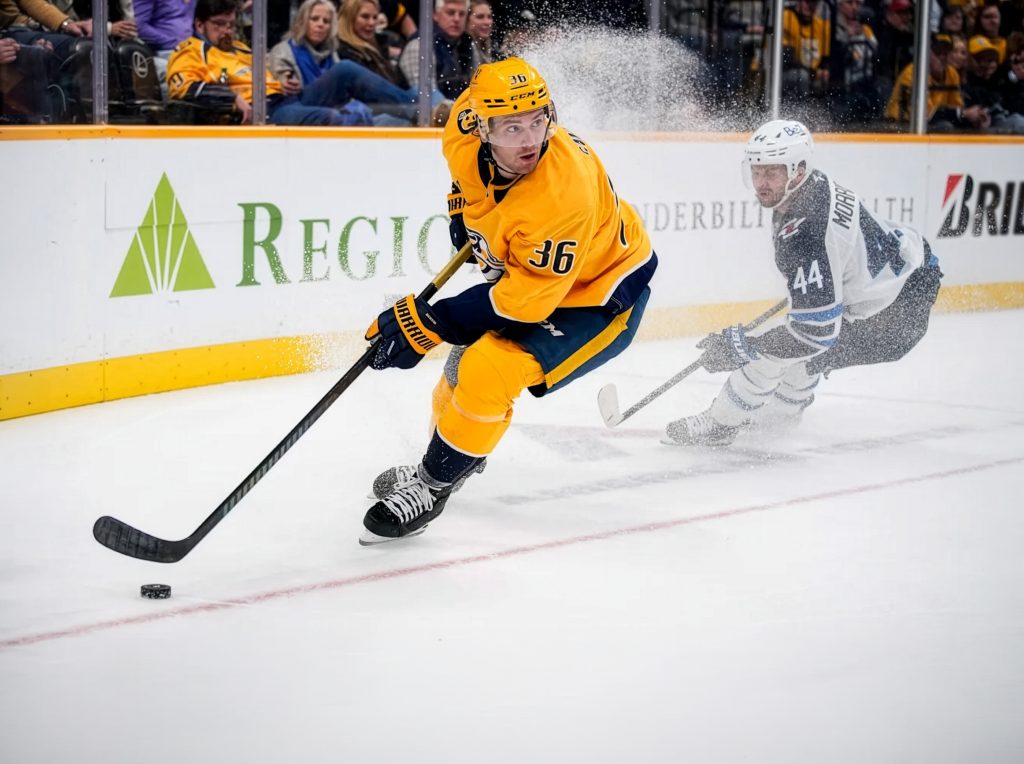
John Stuck has the zeal of a convert. Before moving to the Nashville area, he “hated hockey,” he says. His best friend, though, is a huge fan, and eventually he agreed to take her to a Nashville Predators game.
“I became a superfan overnight,” Stuck says. Since that first game, he’s learned everything there is to know about the sport and personally met most of the team by going to practice sessions. He’s styled his mustache after Filip Forsberg, who plays left wing for the Preds. He even named one of his cats Filip Forsberg. He named the other Roman Josi, after the team captain.
“Before, I was into baseball and football,” Stuck says. “But after learning the sport, this is my favorite thing to do.”
Stuck’s story mirrors the evolution of professional hockey in the city itself, which graduated from a farm team for the Atlanta Knights that generated relatively little attention, to an NHL presence that has produced a new nickname. Nashville’s not just Music City anymore, to hockey fans, this is Smashville.
When the Predators came in 1998, “hockey was not a traditional sport of Tennessee or Nashville,” says Rebecca King, the team’s Vice President of Communications and Executive Director of the Nashville Predators Foundation, the team’s philanthropic arm. “Now, a big portion of our fans haven’t known Nashville without hockey.”
Jessica Rizzardi is one of them. Raised in Franklin, Tenn., a suburb of Nashville, she grew up a Preds fan. Her father had played hockey, and her brother did Preds hockey camps growing up. “We’ve always been a hockey family,” she says. “It’s the most entertaining sport. It’s so fast paced, and every game is different.”
After graduating from college, she decided to try out for the Predators Energy Team, a co-ed squad whose members keep the fans hyped up during the games and serve as brand ambassadors at events. She was hired. “It was a perfect fit for me.” Now in her second season on the Energy Team, Rizzardi, who is also a professional dancer, says the team even invited her to choreograph a performance for a “Women of Smashville” theme night. Theme nights to celebrate a charity, holiday, the military, or just fans themselves, are a big part of Predators culture.
The Predators play in Bridgestone Arena (originally Nashville Arena), a downtown, multipurpose venue on Lower Broadway that also hosts big concerts and events like the SEC Basketball Tournament. At the time it opened, though, “it was not necessarily a desirable place to go. You would come to a game or another event, park in a gravel parking lot, and then you’d leave,” King says. “Now it’s a destination for our fans and for tourists. It’s great for the bars and restaurants, because after a game, 17,000 people are out on Broadway. A lot of outside people who come in see we have a strong hockey market, and so we have a strong away contingency that likes to come and see what
we do in Nashville.”
Rizzardi loves the energy. “One of the reasons so many people want to come to Preds games is because Bridgestone Arena is in the heart of the city,” she says. “My friends and I will go out after the game, and it’s fun to see everyone in their Preds gear. It’s really cool to have this community that extends beyond the game.”
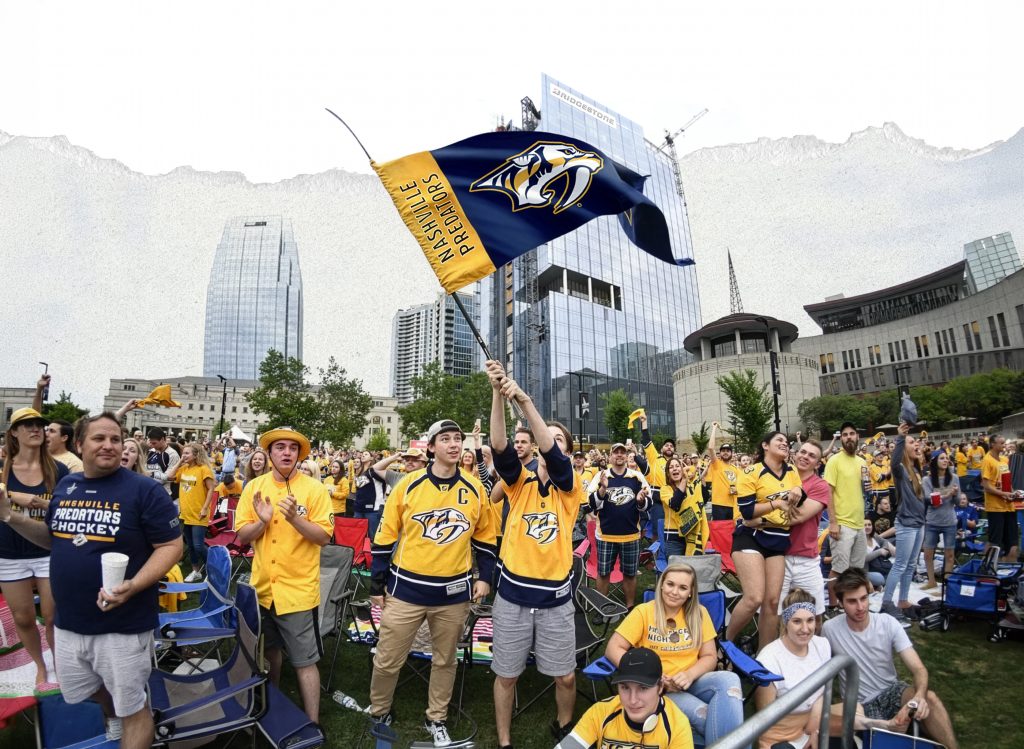
For Stuck, the self-described hockey convert, the party outside sometimes rivals the action inside. On game days, the plaza outside the arena hosts parties with live music and giveaways, often drawing in people from the street who weren’t even planning to go to the game. If the Predators make the playoffs, “that’s the best time outside of the arena, because people bring lawn chairs, they put up a big screen and close off the streets,” he says. He’s watched playoff games both from inside the arena and outside, and “the watch party outside is even better.”
That sense of community runs deeper than game day. The Foundation takes players to visit kids in the hospital — on Halloween, King says, the players dress in themed costumes; last year they were Care Bears. Predators player Ryan O’Reilly, whose parents fostered several kids while he was growing up, buys tickets for any kids in foster care as well as other children dealing with challenges. “They get to come and have a VIP experience,” King says, “and after the game, he will sit and talk with them. They leave feeling like a million bucks.”
King says she has stories like that about every player on the team. “They are phenomenal humans who just happen to be really good at a sport.”
The fans have their own stories, too. In a social-media fan group, one member thanked a stranger who sent him a Preds visor after he lamented that he couldn’t find one. Another posted that he and his wife had recently moved to the area and appreciated the warm greetings they received from locals: “We have been to arenas and stadiums all over the country and rarely see this.”
As for the moniker “Smashville”? Some say it refers to the fan base, others define it as the giant party that surrounds every home game. Says King: “It’s about the high energy, the players knocking against the glass, all of that.” Whatever the origin, the name is here to stay. In 2017, a year all Preds fans remember, the team made its first-ever Stanley Cup Final appearance, and the Tennessee Department of Transportation used its digital highway message boards to spread the word: “Welcome to Smashville.”
“It was a fun way to tell people, yes, they’re coming to Smashville,” King says. “And they identify it with hockey.”


